
Jenny STRUGGLES At Her & Sumit’s Cafe
In the bustling heart of Sumit’s family cafe, a new day begins with the clink of cups and a machine that promises the world of barista perfection. Jenny stands before it, a gleaming contraption of mystery and potential, a rental marvel that supposedly comes with everything—beans, grinder, fresh coffee, the works. It’s supposed to be foolproof, a shortcut to caffeinated glory, but to Jenny it feels almost like a riddle wrapped in chrome. The air hums with possibility, and yet there’s a tremor of doubt in her eyes.
“The real deal,” she whispers, tracing the machine’s glossy surface as if expecting it to reveal its deepest secrets. “There’s nothing like it anywhere else unless you go to Starbucks.” Her voice carries a curious blend of wonder and wariness, as if she’s seen enough to recognize brilliance when it’s staring back at her, but not enough to claim mastery over it. The words tumble out in a rush, a confession to the audience that she’s not fully in control, that a treasure lies just beyond reach.
But if the machine is a potential crown, it also hides a labyrinth. The milk container, that essential piece, seems to vanish into the shadows of the cafe’s clutter. “Okay. I don’t know where that container, the milk container is. Huh? Find it.” Her plea drops like a stone into a quiet pool, ripples of urgency spreading as she realizes she’s being asked to perform a feat she hasn’t mastered. The crowd—family, customers, perhaps even fate—watches with a blend of sympathy and suspense.
In that moment, Shri steps into the frame, a guide with patient hands and a patient heart. He shows her the basics, a beacon of clarity in the fog of uncertainty. Jenny’s voice softens as she admits the truth to the audience: “I’ve been put in charge of the coffee machine by the family, and Shri showed me how to use it, but I’m not totally comfortable with it yet.” The admission lands with a thud, a cue for the drama to rise. It’s not bravado she lacks; it’s familiarity. The machine looms, almost sentient, and she is a novice navigating a labyrinth of dials and grinders just as the clock ticks toward a crucial moment.
Her preparation feels almost domestic and dangerous at once. She can brew coffee at home without a second thought, she says, but this behemoth before her is a different universe. “But this thing, I don’t even know where to start,” she confesses to the audience, eyes darting toward the buttons that gleam like tiny stars. The grinder—so close to becoming her ally—remains an enigma. “Oh, I have to grind the beans. I don’t know how to do that.” The tension tightens, the room narrowing to the focus of a single unhappy truth: she is as far from mastery as the horizon is from the shore.
A line of people begins to form—customers waiting, perhaps a line that will become a chorus of judgment. The pressure mounts as Jenny realizes the gravity of the moment, the possibility of a flawless cup slipping away because she’s still learning the rhythm of this machine. “Papa, I have a customer standing here waiting for his coffee, and I have no idea how to make this grinder work. Sorry minute. How, how, sorry new,” she stammers, the words tumbling out in a rapid-fire confession to the watching audience. Her fear becomes a mirror for us all: when you’re new, every task feels giant, every minute a deadline, every mistake a public display.
The scene pivots, and the energy shifts into a show of misfired potential. The video cuts to a moment of misalignment—a minor catastrophe that carries the weight of a saga. The electricity isn’t flowing; the machine refuses to wake. “Connected electricity. Actually, it’s not plugged in.” A clarion note of irony rings through the air, a dramatic pause that underscores the fragility of progress. There’s a whole world of preparation stuttering to life, only to reveal the simplest truth: the machine wasn’t plugged in. The audience gasps at the revelation, as if the key to a kingdom lay in a forgotten outlet.
Then the scene erupts with a communal energy, the cafe’s chorus reacting to the setback. The group—perhaps a family, perhaps a team—buzzes in the background with a blend of encouragement and critique. The dialogue cuts through: “That’s why it wouldn’t turn on.” It’s a blunt, almost comic, reminder of human error’s power to derail even the grandest plans. Yet within the misstep lies a moment of real learning. The process isn’t just about coffee; it’s about teamwork, timing, and the stubborn, stubborn fact that progress often hinges on something as simple as a plugged-in plug.
A character’s voice—sharp, almost taunting—cuts through the rhythm: “You want me to help you or daddy?” The line lands with a sting, revealing a dynamic of authority and support within the cafe’s family tapestry. Then, a rapid-fire sequence of instruction punctuates the air. “Yeah. First collect. No. No. What do you mean? No. No. That’s how you do it.” The directions arrive in a torrent, the kind of guidance that can either unlock a future or overwhelm a novice’s nerves. The music swells, the laughter of the cafe and the clatter of dishes providing a sonic backdrop to a moment of education under pressure.
The scene crescendos into a flash of bold determination—a decision to salvage the moment, to fight through the fear with quick, decisive action. The words feel like a vow: “That’s a bad sale. D. You have to try to do very quick.” The command floats in the air, a call to armory of nerve: to learn, to pivot, to perform under the bright glare of a customer’s eyes. The sense of suspense thickens, as if we’re watching a climactic trial where a single successful cup could turn the tide of confidence forever.
And then a surprising, almost defiant pivot: “You know what? what I can do. I can go home. That’s what I can do.” The statement lands like a final, exasperated note in a symphony of nerves. It’s a moment of vulnerability, a choice to retreat or to persevere, a raw human beat in a scene otherwise tinted with comedic tension. The words “I can go home” carry a dual weight—one foot out the door, and yet—are we about to witness a brave turn? The atmosphere tightens as the camera lingers, inviting us to witness the next beat in this unfolding drama.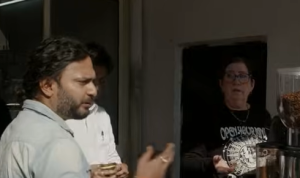
In this kitchen theater, the coffee machine remains a silent, gleaming antagonist and ally in equal measure. It promises a future of perfect lattes and velvety crema, yet it tests every nerve in Jenny’s body—the nerves of courage, of patience, of being seen and judged in front of those who matter most. The audience leans in. The family leans in. The machine hums with the possibility of redemption, or another stumble that could echo through the cafe like a bell toll.
As the credits roll on this tense vignette, we’re left with a question that feels almost philosophical: will Jenny conquer the beast before her—the grinder’s grind, the machine’s mind, the clock’s relentless march? Or will the moment be stolen by doubt, a spill, a misplugged plug, a missed cue? The answer lingers in the air, suspended between the clatter of cups and the quiet heartbeat of a hopeful apprentice learning to wield a machine that might one day become her loudest supporter—and, for now, remains a test of nerve, a drama of steam, a saga of human craft under the bright, unforgiving light of the cafe.